


Nail fungus is a disease caused by various groups of pathogens.To destroy it, you will need to undergo diagnostics to identify all the characteristics of the disease.What are the reasons for it?There are many reasons for the appearance of a fungal infection and prerequisites for its occurrence.
Genetic causes of the disease
Fungal spores can remain on various surfaces for years.Humans often encounter pathogenic microorganisms, but infection does not always occur.In order for nail fungus to appear, the presence of predisposing factors is necessary.The infection must have conditions for development.Scientists have conducted many studies on the mechanism of the disease.
It turned out that one of the factors for the appearance of a fungal infection is genetic predisposition.According to these studies, mycosis most often occurs in people whose relatives have a similar disease.The progression of the disease affects the genetic level.
Interesting cases of infection during cohabitation.With close contact, it is easiest to get mycosis.However, it often develops in one member of the household but does not affect another.And the disease usually occurs in a person who has genes most similar to the one who originally developed mycosis.All these data suggest that contact proximity is less important during infection than genetic linkage proximity.
Mycosis symptoms
Nail fungus manifests itself differently at different stages.Usually, a ringworm infection begins in the spaces between the toes.At this time it is observed:
- The appearance of bubbles;
- Redness of the skin;
- itching
If treatment is not carried out at this stage, the disease begins to affect the nails.In this case, the following signs are detected:
- Dullness of the nail plate, loss of transparency;
- The appearance of white streaks and spots;
- Uncomfortable sensations.
It is better to conduct treatment at this stage, as this will reduce the cost of therapy.To destroy microorganisms, external preparations will be sufficient: ointments, varnishes.If left untreated, nail fungus will progress.This is expressed through the following symptoms:
- Thinning or thickening of the nail;
- Delamination of the nail plate;
- Its departure from the nail bed;
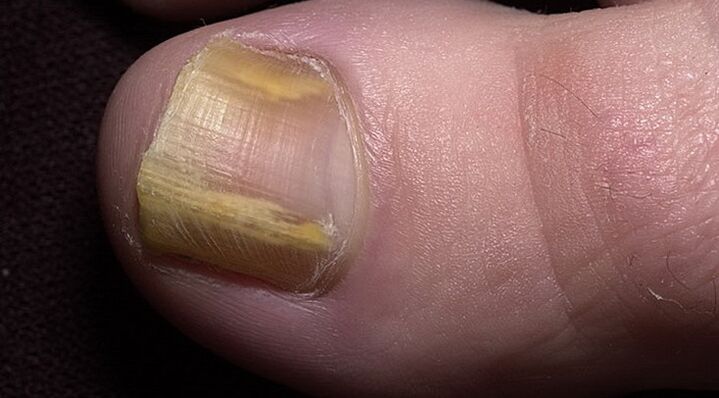
- The plate acquires an unusual color: it becomes white, yellow or black;
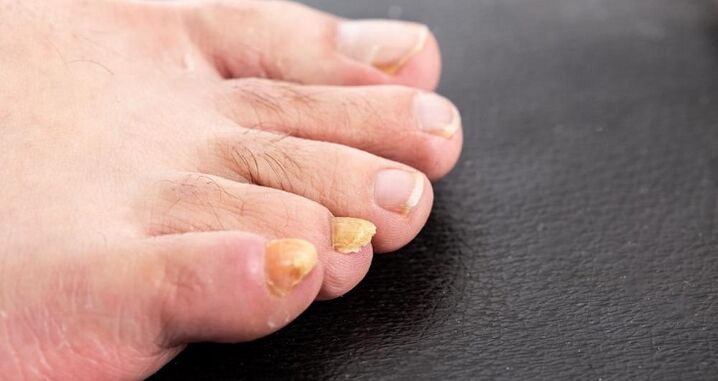
- In the final stages, the nail literally crumbles, collapses, and an unpleasant odor may appear.
Mycosis carries out its pathological activity not only on the toenails.Inflammatory processes affect the entire foot.
It starts to redden and peel.The patient feels itching, which intensifies during periods of exacerbation.The presence of characteristic signs allows you to identify the disease during the initial examination.
Types of fungal infections
Nail fungus is divided into types depending on which group of microorganisms it is caused by.There are three main groups:
- dermatophytes.The most common case.This group is the cause of mycosis in 95% of cases;
- Candida.These yeast-like microorganisms contribute to the thinning of the nail plate.He begins to turn yellow and lag behind his bed.The lesion starts at the nail fold.As the disease progresses, swelling appears.In some cases, pus may be released.The skin of the plaque stops growing and therefore turns brown.The nail crumbles.These groups of microorganisms usually develop in women.There are risk groups - housewives who constantly deal with household chemicals.Acts aggressively on the skin, which opens "doors" for infections;
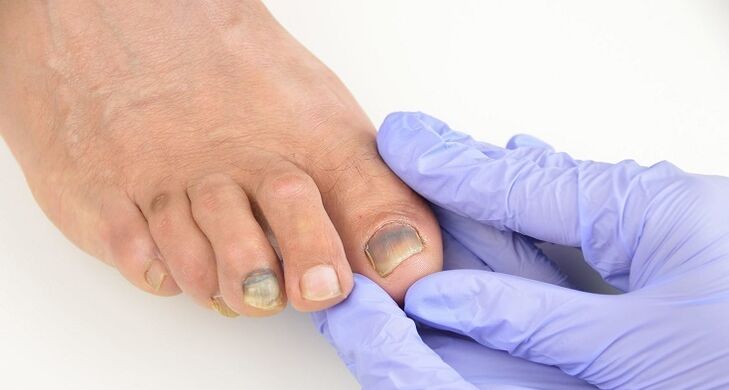
- Types of molds.These groups of microorganisms cannot penetrate deep into the nail plate.This prevents its complete destruction, but the disease is fraught with other effects.The nail strongly changes its color.It can acquire a black, blue, green hue.
Treatment depends on the group of microorganisms, since different pathogenic microbes respond differently to drugs.Sometimes three types of fungi are found during diagnostics.In this case, complex therapy will be required.
Fungal forms
There are different stages of the disease, which differ in the type of lesions:
- Normotrophic.There is a change in the color of the nail plate.It may turn yellow and lose transparency.White and yellow streaks or dots appear.The difference between the disease is that the nail is not subject to significant deformation.Sometimes it can even retain its former luster;
- Atrophic.The nail becomes thinner and completely loses its shine.Pronounced white and yellow stripes and dots appear, representing specific foci of infection;
- Hypertrophic.The plate changes significantly.Thickening and signs of decay are observed.It becomes porous.Severe pain syndrome, aggravated during movements and wearing tight shoes, is also possible.The disease can limit a person's activity.
The prescribed treatment regimen depends on the stage as well as the type of microorganisms.In the first stages, external means of protection proved effective.In the later stages, the treatment regimen is usually a combination of external drugs and means for internal use.
Where can you get a yeast infection?
Nail fungus is usually passed from person to person.Microbial spores can remain on surfaces.When you touch them, the fungus will remain on the feet and begin to grow.You can catch ringworm in the following places:
- Public institutions: saunas, swimming pools, showers of sports clubs.This is the most likely way to get the fungus, as it multiplies most actively in warm and humid conditions.To protect yourself from it, it is necessary to carry out preventive treatment of the feet with drugs before going to the institution.You must bring your own slippers;
- If mycosis occurs in a family member, the likely way for the disease to occur in other family members is through bathing.Fungal spores that cause mycosis remain on its walls.For protection, it is necessary to treat surfaces with disinfectant compounds after each visit to the bathroom;
- Sometimes the cause is a manicure or pedicure done with tools that have not been disinfected after previous use.This applies to procedures carried out in beauty salons;
- Controversies can be hidden in shoes in stores because they are often tried on by different people.For protection, you can try toe-only shoes;
- Public beaches are a less likely source of infection because nail fungus does not survive well in salty sand.
To prevent the disease, you should not forget the importance of personal slippers and use preventive measures.
Possible complications with long-term treatment
Mycosis is characterized by the speed of development and spread.If the treatment is delayed, the symptoms of the disease will become more and more obvious.Initially, a person is concerned about the aesthetic factor, as thickenings and white dots appear on the toenails.But if you do not deal with the problem, more serious consequences will occur - pain when moving, itching and burning.Let's look at the most likely consequences of prolonged treatment:
- Other infections are likely to occur as the body weakens;
- Exacerbation of diabetes mellitus.The appearance against the background of an infectious process of gangrene or infection of bone tissue.All this can lead to the need for amputation of a limb;
- If nail fungus is not treated for a long time, the body can react to it with hypersensitivity and allergic reactions.Against their background, allergic dermatitis, skin diseases and bronchial asthma worsen;
- The final stage of mycosis is damage to the internal organs.The infection begins to spread throughout the body.This can be fatal.
Another important consequence of untimely initiation of therapy is significant financial costs.In the final stages, the disease is not only more difficult to treat, but also more expensive.You will have to spend money on local treatments and pills.Really effective drugs are more expensive.In some cases, even surgery may be prescribed.
Preventive measures
Nail fungus can be prevented, which is what preventative measures are aimed at.They help prevent the entry and further spread of pathogenic microorganisms.Prevention is quite simple and consists of following the following tips:
- Exceptions are narrow shoes, incorrectly chosen last.All this leads to the appearance of corns and other deformations through which the infection penetrates;
- You should not wear synthetic socks and tights as your feet will sweat in them.Sweat and a moist environment are the best conditions for the growth of fungi;
- You must maintain personal hygiene, wear slippers when entering public places, and pre-treat your feet with preventive means;
- After each washing of the feet, the interdigital areas are thoroughly dried;
- Socks and stockings should be changed every day;
- You cannot wear other people's shoes;
- The house must be kept clean, for which periodic disinfection is carried out.
Prevention is aimed at two goals - preventing infection and stopping its development in case of possible ingestion of spores.To achieve the second goal, you will need to take care of your immune system: exercise, eat right.
Methods of treatment
Nail fungus usually takes a long time to heal.The duration of therapy, regardless of the cause of the disease, will be from 6 months to one year.The advantage is that most drugs can quickly relieve symptoms.But despite the disappearance of symptoms, it is necessary to continue the therapy until the microorganisms are completely destroyed.
External drugs are used for treatment in the early stages.These include:
- Special varnishes;
- Creams and gels;
- Solutions and tinctures.
In the later stages, oral medications are added to external medications:
- tablets;
- antibiotics.
Varnishes are especially popular.They give two effects at the same time: they destroy the existing microorganisms and create a film that will prevent the entry of new infections.The product is able to penetrate deep into the nail.It is colorless and odorless, so it can be used by men.Before use, it is recommended to remove the nail plate to ensure deeper penetration.
Ointments and gels are gentle.They are easy to use.Rapid relief of symptoms.With the help of drugs, you can treat not only the nails, but also the skin around them.The downside is that the product can be quickly washed off the skin.To prevent this, you can apply compresses: a cotton swab, secured with a bandage, is placed on top of the ointment layer.
In severe cases, tablets are prescribed.This product has a strong effect, is toxic and has contraindications.For this reason, the therapy is carried out under the supervision of a doctor.
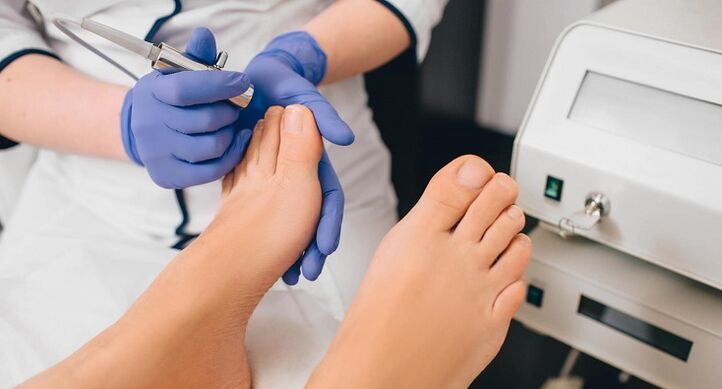
If the case is completely advanced, surgical intervention comes to the rescue.During the operation, the affected nail is removed.It can be removed without surgery.Special means are used for this.The last option is painless.
Nail fungus is an extremely common problem.Its cunning lies in the fact that in the first stages the signs of the disease are insignificant.The patient can constantly postpone the treatment, since he does not feel discomfort.All this leads to neglect of the problem.To solve it, you will need a lot of funds and medicines.Mycosis spreads rapidly, resulting in pain, detachment of the plaque, unpleasant odor and modification of the nail.